
“Margin Call” in the age of “Epic Fury”
What separates the bankers of 2008 from the people running the Iran War? The difference between cynicism and cruelty.
The allegations of insider trading tied to the Iran war had a familiar shape: people close enough to power to know what was coming using their knowledge of a pending catastrophe to profit before it became public.
For millennials, elite impunity and financial markets intersecting tends to summon 2008. And then I found myself thinking about how much worse this is. The villainy of the people responsible for the greatest economic catastrophe since the Great Depression looks, from today’s vantage, almost quaint.
It’s one thing to knowingly spread toxic assets across the market in the hope that your employer won’t be left holding the bag; it’s another to see the death and destruction of a war of choice as a chance to get that bag.
So I decided to rewatch Margin Call and see if I could understand, on a characterological level, this process of moral degradation.
“I’m here for one reason and one reason alone.”
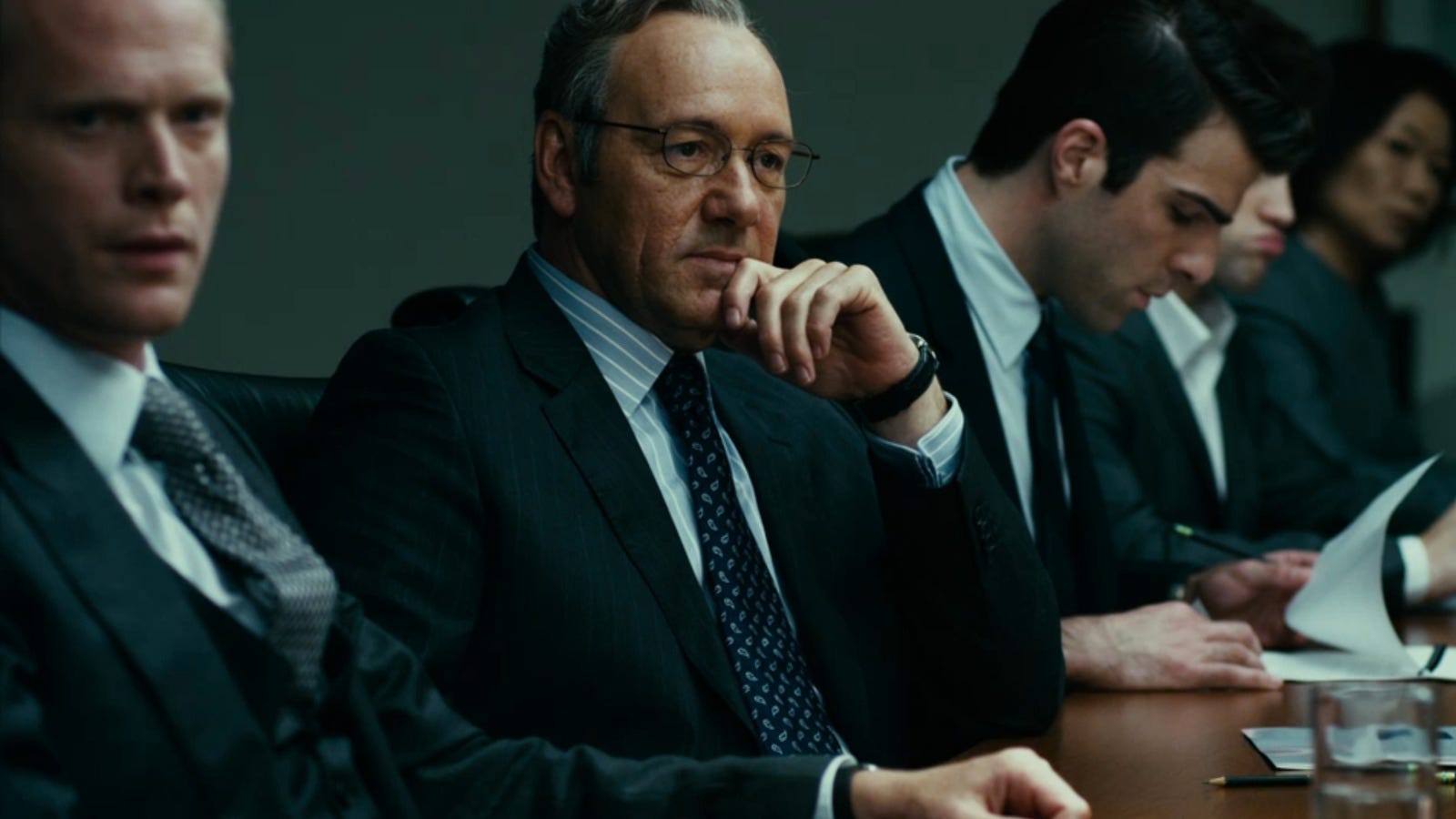
The film, which was written and directed by J.C. Chandor, takes place over a single night at a large investment bank.
The people running “the firm,” as they call it, have just discovered they are holding investments that are so bad that they threaten to overwhelm the company’s entire market capitalization — so bad that, if they don’t spread the poison throughout the market before anyone else knows, the whole company will go under.
The film’s most powerful figure is John Tuld (Jeremy Irons), the CEO who arrives by helicopter in the small hours and decides, before dawn, to dump the firm’s entire toxic position onto an unsuspecting market. As he puts it:
Do you care to know why … I earn the big bucks? I’m here for one reason and one reason alone. I’m here to guess what the music might do a week, a month, a year from now. That’s it. Nothing more. And standing here tonight, I’m afraid that I don’t hear a thing. Just silence.
When pushed, he continues:
What have I told you since the first day you stepped into my office? There are three ways to make a living in this business: be first, be smarter, or cheat. Now, I don’t cheat. And although I like to think we have some pretty smart people in this building, it sure is a hell of a lot easier to just be first. Sell it all. Today.
Cynical as he may sound, nothing Tuld says here is untrue.
When Sam Rogers (Kevin Spacey), his head of sales, warns him that they’ll be selling assets they know have no value, Tuld cuts him off: “We are selling to willing buyers of the current fair-market price. So that we may survive.”
Tuld is not a deep thinker. He jokes at one point that a junior colleague should explain the situation by speaking to him “as you might to a young child. Or a golden retriever.”
But he isn’t full of shit. He knows who he is. He knows the business he’s chosen.
“The fear that they might jump”
The more interesting characters are the ones who haven’t made that peace, the ones who are living in what Sartre would call bad faith.
Rogers is one example. His sudden bouts of conscience, despite working at the firm for more than 30 years, are both sympathetic and, in context, risible. He bridles when Tuld accuses him of “going soft” — but after Tuld hands him a piece of paper with a “very generous” number on it, he follows orders.
Rogers’ guilt is real. It is also, entirely, beside the point.
Will Emerson (Paul Bettany) is the film’s most volatile figure, and its most revealing one. Whereas Rogers pretends to have less agency than he does, Emerson imagines he has more.
He is 10 years into a career he regards with sardonic detachment. He spent $76,520 last year on, as he puts it, “hookers, booze, and dancers. But mainly hookers.” He jokes that if he doesn’t get nicorette soon, he’ll be forced to kill somebody.
Early in the film, before Tuld arrives, Emerson climbs onto the ledge of the firm’s skyscraper roof and looks down over the city. His younger colleagues tell him to get down. Before he does, he offers this:
The feeling people experience when they stand on the edge like this isn’t a fear of falling. It’s the fear that they might jump.
“That’s very deep and depressing,” one of his underlings shoots back. “Yeah, well, I’m a little dark sometimes,” Emerson says.
Then, after another bitter joke — “Not today!” — he gets down and says: “It looks like they’re going to make us dump this shit. You watch.”
Later, driving back to Manhattan from Brooklyn, Emerson explains himself to one of the men he spoke with on the roof:
Listen, if you really want to do this with your life, you have to believe you're necessary. And you are. People want to live like this, in their cars and the big fucking houses they can't even pay for, then you're necessary. The only reason that they all get to continue living like kings is because we've got our fingers on the scales in their favor.
I take my hand off, then the whole world gets really fucking fair really fucking quickly, and nobody actually wants that. They say they do, but they don't. They want what we have to give them, but they also want to play innocent and pretend they have no idea where it came from. That's more hypocrisy than I'm willing to swallow.
“So,” he concludes, “fuck normal people.”
The difference between Emerson and Tuld
Emerson’s real foil is not Rogers but Tuld. The difference between them isn't conscience versus cold rationalism; it’s bitter disillusion vs. unbothered fatalism.
But where Emerson's cynicism is performed, Tuld's fatalism is almost terrifyingly sincere. Confronted at the end of the film by Rogers, who demands to be let go as a kind of penance for what they’ve done, Tuld responds:
When did you start feeling so sorry for yourself? It’s unbearable.
So you think we might have put a few people out of business today. That’s all for naught. But you’ve been doing that every day for almost 40 years, Sam. And if this is all for naught, then so is everything out there. It’s just money. It’s made up, pieces of paper with pictures on it so that we don’t have to kill each other just to get something to eat. It’s not wrong. And it’s certainly no different today than it’s ever been…
We can’t help ourselves. And you and I can’t control it or stop it or even slow it down. Or even ever so slightly alter it. We just react. And we make a lot of money if we get it right. And we get left by the side of the road if we get it wrong.
Emerson's argument is organized around contempt for "people" — their hypocrisy, their appetites, their need to play innocent. He hates that they render someone like himself “necessary” — and that without him, “the whole world gets really fucking fair really fucking quickly,” something that “nobody actually wants.”
The difference between Emerson and Tuld can be seen in their points of emphasis. Unlike Emerson, Tuld doesn’t talk about “people” — he talks about “we.” He doesn’t say people can’t help themselves; he says “We can’t help ourselves.” And he doesn’t say that he and Rogers have their fingers “on the scales,” but rather that, “you and I can’t control it or stop it or even slow it down … We just react.”
Tuld does not imagine himself as a moral or civic leader. As he says earlier in the film, his job is “to guess what the music might do a week, a month, a year from now. That’s it. Nothing more.” But by absolving himself he absolves everyone else.
He does not say “fuck normal people.” He says: “It’s not wrong. And it’s certainly no different today than it’s ever been.”
From the Great Recession to Operation Epic Fury
Nearly 20 years have passed since the events depicted in Margin Call. I don’t know where Will has ended up. Maybe he’s in early retirement, living in New Zealand, meditating and getting into woodworking.
But I do know where the US has ended up. And the road from there to here has been paved by people like Emerson — angry, bitter, and disillusioned elites who have opted to give the “normal people” what they supposedly both deserve and want.
In early March, the US and Israel launched a sweeping attack on the nation of Iran that the US has called Operation Epic Fury (OEF).
As American and Israeli missiles have continued to fall on Iran, killing more than a thousand civilians so far, the White House has posted a series of videos on social media splicing together actual war footage and clips from video games and action movies.
The videos are willfully transgressive, likely designed to send a different message to two distinct audiences. For the primary audience — the kind of people who post all day on X about how international law is for “simps” who suffer from “suicidal empathy” — the message is clear: It is “based” when the US military kills people.
For the second audience, however, the message is even more unvarnished: You want to be innocent? You want to imagine you can live your lives as Americans without having to sully your consciences by supporting violence against its “enemies”? Fuck you. That is more hypocrisy than we’re willing to swallow.
Unlike Tuld, who celebrates the market, even at its most heartless, because it allows humans to avoid “kill[ing] each other just to get something to eat,” the heirs of Emerson in the Trump Administration celebrate “maximum lethality, not tepid legality.” They talk about their kitschy videos of mechanized death as “banger memes.”
The world Tuld presides over accepts unjust outcomes as a necessary price for a great harmony; the one Emerson’s heirs have built celebrates cruelty as a kind of meaning in itself.
Watching Margin Call again, I kept thinking about the difference between the Olympian remove of a man like Tuld and the barely suppressed hatred of a man like Emerson. They may be two evils, but one is clearly the lesser.