
This is what losing sounds like
Why Trump's Iran speech reminded me of Alexander Garland's “Civil War”
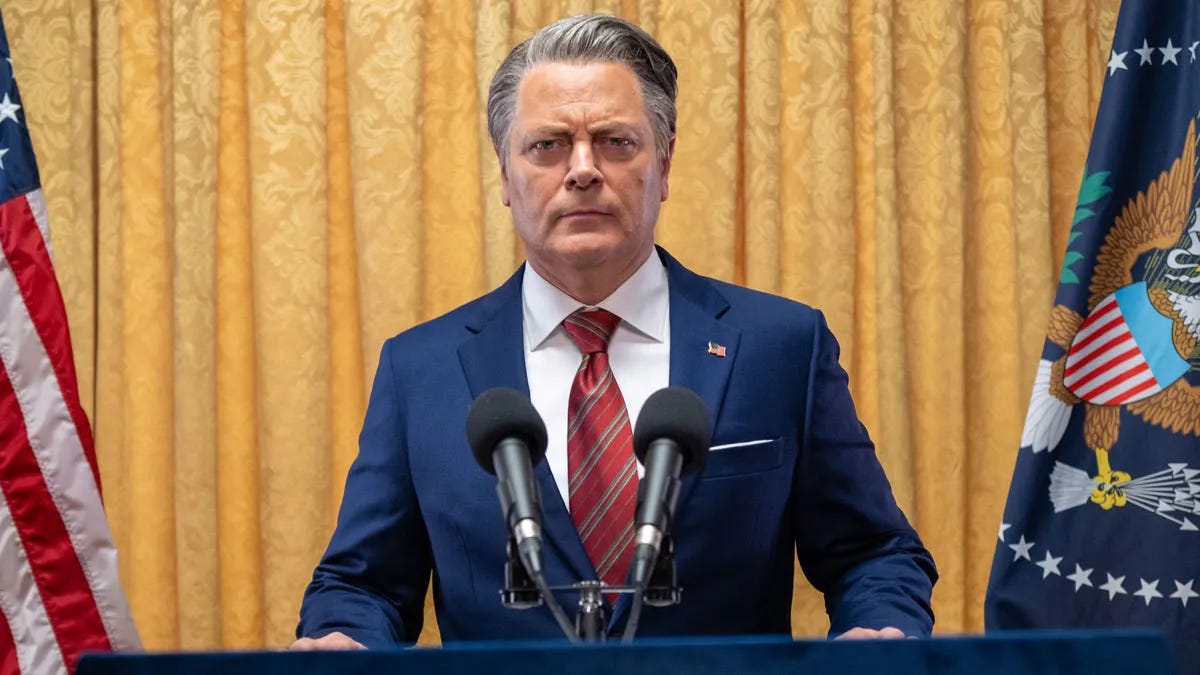
I did not expect much from President Trump’s April 1 address about his war of choice against the Islamic Republic of Iran.
Trump’s presidential addresses are, from a basic aesthetic standpoint, uniformly terrible. His delivery is labored. He sounds like someone who fears reading in public and resents any situation that makes this especially conspicuous. He makes the presidency seem like a small and piddling thing.
But what made me double-plus sure the remarks would amount to less than zero was the topic itself: his world-historically stupid decision to launch a legally dubious and strategically ruinous war he reportedly finds “boring” and that has already spun far beyond his understanding or control.
It’s not just that he’s losing; it’s that he sounds like he knows it.
“Never before…”
If you’re an unusually mundane masochist, you can watch the whole thing above. (I’ll only moderately kink-shame you, I promise.) But the part of the speech I want to focus on, the part where I believe he reveals, despite himself, his awareness of his escalating failure, came early.
From Trump (emphasis mine):
As we speak this evening, it’s been just one month since the United States military began Operation Epic Fury, targeting the world’s number one state sponsor of terror, Iran. In these past four weeks, our armed forces have delivered swift, decisive, overwhelming victories on the battlefield. Victories like few people have ever seen before.
[…]
Never in the history of warfare has an enemy suffered such clear and devastating large-scale losses in a matter of weeks. Our enemies are losing, and America, as it has been for five years, under my presidency, is winning, and now winning bigger than ever before.
[…]
We are systematically dismantling the regime’s ability to threaten America or project power outside of their borders. That means eliminating Iran’s navy, which is now absolutely destroyed. Hurting their air force and their missile program at levels never seen before. And annihilating their defense industrial base.
[…]
Our armed forces have been extraordinary. There’s never been anything like it militarily. Everyone is talking about it.[…]
The whole world is watching, and they can’t believe the power, strength and brilliance. They just can’t believe what they’re seeing. They leave it to your imagination, but they can’t believe what they’re seeing, the brilliance of the United States military.
[…]
Because of the actions we have taken, we are on the cusp of ending Iran’s sinister threat to America and the world. And I’ll tell you, the world is watching.
As you might imagine, I’ve cut out a lot — the lies, of which there were many, and the statements that contradict each other in almost sequential order — but even without my excisions the basic propaganda is, as always, punishingly obvious:
Like few have ever seen before. Never in the history of warfare. Winning bigger than ever before. Hurting their air force and their missile program at levels never seen before. There’s never been anything like it militarily. Everyone is talking about. They just can’t believe what they’re seeing … they can’t believe what they’re seeing.
10 years into the experience of President Trump — first as candidate, then reality, then specter, then reality once again — I think even the most news-avoidant Americans understand that this is what Trump sounds like when he knows things aren’t going well.
As we saw in his response to his defeat in 2020, it’s not enough to say that a loss was actually a win. It’s necessary to say that the loss was not only a win but the greatest victory of all time. It’s not enough to say that down is up; it’s necessary to say that down is the most up that up has ever been, and that up is down to a degree the world has never seen before.
It’s all so tedious — and, yes, pathological. But there’s a method to it, too.
That method is best summarized by two of the more famous quotes from Hannah Arendt’s Origins of Totalitarianism which, taken together, offer a useful guide to how Trump and his acolytes approach “messaging” (a flattering euphemism Americans use to talk about our own propaganda).
The first:
The ideal subject of totalitarian rule is … people for whom the distinction between fact and fiction (i.e., the reality of experience) and the distinction between true and false (i.e., the standards of thought) no longer exist.
And the second:
Mass propaganda discovered that its audience was ready at all times to believe the worst, no matter how absurd, and did not particularly object to being deceived because it held every statement to be a lie anyhow. The totalitarian mass leaders based their propaganda on the correct psychological assumption that, under such conditions, one could make people believe the most fantastic statements one day, and trust that if the next day they were given irrefutable proof of their falsehood, they would take refuge in cynicism; instead of deserting the leaders who had lied to them, they would protest that they had known all along that the statement was a lie and would admire the leaders for their superior tactical cleverness.
What Arendt is describing, and what Trump so often embodies — though I am absolutely fucking positive that he has never read a single word Arendt wrote — is the basic conviction that the people, the masses, are both stupid and desperate to be lied to.
That this kind of lying, baldfaced and almost performative as it is, provides those who accept it a means of escaping a reality they find disempowering and overwhelming. That to savvily recognize how you’re being manipulated is, somehow, a sign of your own power.
“The greatest victory in the history of mankind”
Dispiriting as Trump’s address was, it did at least remind me of one of my favorite movies of recent years, Alexander Garland’s Civil War.
In the opening of that film, we see a character simply known as The President (Nick Offerman) preparing to deliver a speech to what remains of the failing rump-state once known as the United States of America. The movie begins with the President practicing his lines (he’s got that much on Trump, I guess!) for a public address.
And while, at this point, the viewer doesn’t know whether the President is winning his war or not, once they hear what he actually says, it’s abundantly clear that he is absolutely not.
Here’s what he says to himself as he readies to go live:
Some are already calling it the greatest victory in the history of mankind…
Some are calling it already…
We are closer than we have ever been to victory…
Some are already calling it the greatest victory in the history of military campaigns…
And then here is what he ultimately says once the cameras are rolling:
Today, I can announce that the so-called Western Forces of Texas and California have suffered a great loss. A very great defeat at the hands of the fighting men and women of the United States military.
The people of Texas and California should know that they will be welcomed back to these United States as soon as their illegal secessionist government is deposed.
I can also confirm that the Florida alliance has failed in its attempt to force the brave people of the Carolinas into joining the insurrection.
Citizens of America, we are now closer than ever to a historic victory. As we eliminate the final pockets of resistance, God bless you all and God Bless America.
As the movie unspools, we soon find out that the United States is not winning — that, in fact, the rebel forces that were supposedly handed “a very great defeat” are preparing for a final siege of DC and that this president’s days are numbered.
But this doesn’t come as a surprise. We knew, from the moment we first heard the President mumbling to himself about “the greatest victory in the history of mankind,” that we were listening to a failure.
“The hard part”
So where does this likely lead?
In Civil War — spoiler alert — it leads to the President (Offerman) getting executed on the floor of the Oval Office. It’s a pyrrhic victory of sorts — the point of Civil War, among other things, is that most modern civil wars don’t really have winners so much as one side that loses less — but it’s a victory all the same.
The same logic applies to Trump’s war, and it’s inseparable from the idiocy that has defined his “excursion” from the jump.
Zero-sum-minded as he is, Trump cannot understand that war is one of the most obvious arenas in life where it is possible for both sides to lose. Yes, one side can lose more than the other — Iran’s military is definitely losing much more than is the US — but losing less is not the same as winning.
And while I doubt Trump is capable of understanding this in a deep sense, I do think we can see, not only in his administration’s actions but in his address to the nation, that he understands that Iran’s decision to close the Strait of Hormuz has placed him in a kind of strategic checkmate.
From Trump (emphasis mine):
We’ve beaten and completely decimated Iran. They are decimated both militarily and economically and in every other way. And the countries of the world that do receive oil through the Hormuz Strait must take care of that passage. They must cherish it. They must grab it and cherish it. They can do it easily. We will be helpful, but they should take the lead in protecting the oil that they so desperately depend on.
So to those countries that can’t get fuel, many of which refuse to get involved in the decapitation of Iran, we had to do it ourselves. I have a suggestion. No. 1, buy oil from the United States of America. We have plenty. We have so much. And No. 2, build up some delayed courage — should have done it before, should have done it with us, as we asked. Go to the strait and just take it, protect it, use it for yourselves. Iran has been essentially decimated. The hard part is done, so it should be easy.
If the United States were insulated from global markets — if the closing of the Strait of Hormuz did not effect prices everywhere, including at gas stations across the country — then Trump might maybe kinda-sorta have a point. But it isn’t; so he doesn’t.
But whether or not the US “needs” oil from the Strait, American consumers definitely need cheap gas. And the US economy definitely needs to avoid another oil-shock-induced recession like the ones in the 1970s. Those are fixed facts. They will not change, no matter how many times Trump claims he’s done something the likes of which the world has never seen before.
The question, then, isn’t so much what Trump will do. (For all the propaganda about his mercurial and unpredictable nature, he is actually incredibly easy to anticipate.) The question is whether the American people have reached the stage of epistemic degradation that Arendt warned us about.
When gas prices keep going up, and when the already rickety economy starts to show major strains, will voters “protest that they had known all along that the statement was a lie and … admire the leaders for their superior tactical cleverness”? Or will they do what they so often do: Get mad as hell, insist they’re not going to take it any more, and vote for whichever party happens to be the opposition?
I don’t know the future. But I can tell you something about the present. As of this writing, Trump’s approval rating on the economy, according to CNN, is 31 percent.